What are the rules for water tank cleaning and certification in Singapore?
For MCSTs and building owners the rules are specific, and they are enforced.
- Every 12 months, the person responsible for the water service installation must engage a PUB Licensed Plumber to inspect the water storage tank, clean and disinfect it where necessary, and certify it.
- Water samples from the tank go to a laboratory accredited by the Singapore Accreditation Council (SAC-SINGLAS). PUB accepts only accredited reports.
- Certification is submitted to PUB. PUB sends reminder emails to help MCSTs and building owners track the date, but its advice is not to wait for the reminder before engaging a Licensed Plumber.
- Late certification is an offence under the Public Utilities (Water Supply) Regulations. The penalty is a fine of up to $10,000, imprisonment of up to 12 months, or both.
- The technical standard behind all of this is SS 636, the Code of Practice for Water Services, which also governs how the tank is installed, secured and kept clear for inspection.
This is why the water in a condominium or an office block is, in practice, checked at least once a year by someone with a licence to lose. The system works. Magtech has installed and replaced tanks under it for thirty years, and the annual certificate is one of the first documents a building manager asks us about. Our guide to water tank cleaning and certification covers the process in more detail, and we can put you in touch with the cleaning partners we work with.
Why landed houses are the gap
Here is the part most homeowners do not know. PUB states that the mandatory annual certification of water storage tanks does not apply to landed residential properties with a water storage tank after the sub-meter. The owner is still responsible for keeping the tank clean and the water safe. But nobody is required to certify it, nobody samples it, and no reminder email arrives.
In a condominium the MCST cannot forget, because PUB will fine them. In an HDB block the Town Council washes the tanks on schedule. In a landed house the only person who can forget is the owner, and the tank is in the one place in the house nobody looks: on the roof, in the roof void, or behind a hatch above the ceiling.
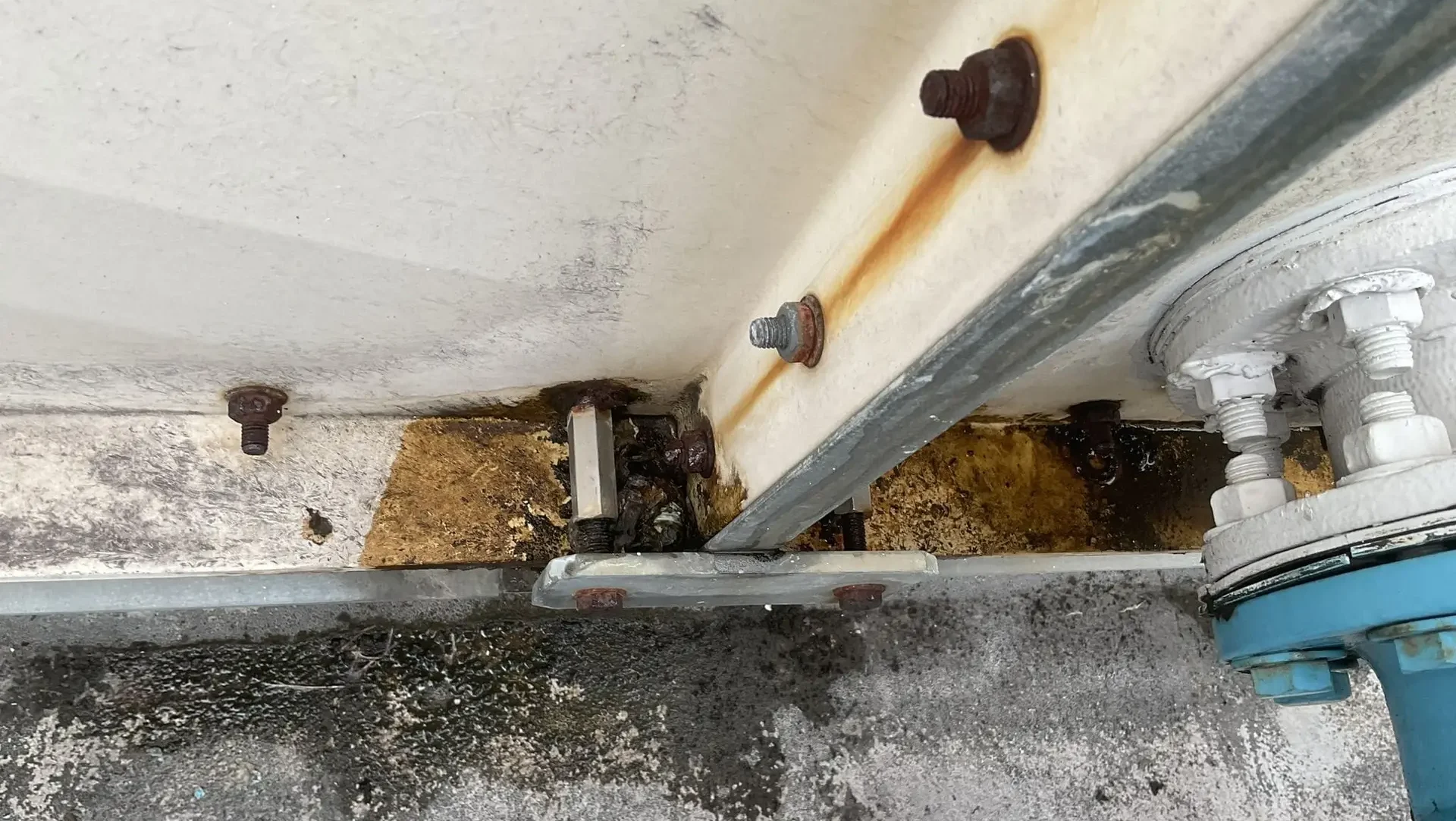
What we find when we are called to a landed-property tank:
- Years of unwashed sediment on the floor of the tank, stirred up every time it refills.
- A tank that is not fully enclosed. A cover that does not seal, a missing vent screen, a gap at the pipe entry. That means insects, lizards and other creatures can get into your drinking water.
- Long-term leakage that was never sorted out, at a panel joint or a fitting, quietly running for years.
- Algae growth where light gets in.
None of this shows up in PUB’s numbers, because PUB’s numbers stop at the meter. It shows up as a tap that runs brown after a holiday, a taste in the morning, or something floating in the glass.
If you own a landed property, the practical answer is simple. Find out when the tank was last cleaned. If you cannot answer that, it is time. Magtech does not carry out tank cleaning ourselves, but we work with cleaning partners who do, and we will recommend one. If the tank itself is leaking or past saving, that is our work. Contact us with a photo of the tank if you can reach it.
What can old pipes in older estates do to your water?
The tank is one half of the story. The pipes are the other, and this applies to flats and older houses as much as to landed property.
Older buildings in Singapore commonly used galvanised iron for internal water supply pipes. Galvanised iron is mild steel with a zinc coating. The zinc protects the steel for years, then wears through, and from that point the pipe corrodes from the inside out. This is not a Singapore-only problem, but Singapore’s warm water and long pipe runs in high-rise buildings do it no favours.
What a corroding galvanised pipe does to the water at your tap:
- Discolouration. Brown, yellow or orange water, most often first thing in the morning or after the flat has been empty for a few days. That is iron oxide, rust, lifting off the pipe wall as flow restarts. PUB’s advice is to run the taps for 10 to 15 minutes and, if the water does not clear, to call PUB.
- Sediment and particles. Flakes of scale and rust that collect in tap aerators, shower heads and the bottom of the kettle.
- Metallic taste and smell. Dissolved iron at levels well below any health limit is still easy to taste.
- Falling flow. Rust and scale build up inside the pipe until a 20 mm pipe is passing water through a hole the size of a pencil. Low pressure at an upper-floor tap is often this, not the pump.
- Pinhole leaks. The end state. Corrosion eventually goes through the wall, and the first sign is usually a damp patch on a neighbour’s ceiling.
Two things worth keeping in proportion. First, iron and rust are an aesthetic problem, not a health one. Neither WHO nor PUB sets a health-based limit for iron; PUB reports it as a measured range. Second, boiling the water does nothing for any of this. Boiling deals with microbes. It does not remove rust, sediment or dissolved metals, and it concentrates whatever is dissolved.
PUB has been tightening the supply side for years. Its Stipulation of Standards and Requirements for Water Fittings removed galvanised iron and malleable iron pipe fittings with plastic core from the approved list, and states that from 1 March 2022 they are no longer allowed for supply and installation in Singapore. New work is done in copper, stainless steel and approved plastics. But the rule applies to new installation. The pipe already in the wall of a 1980s flat stays there until someone replaces it, and that is a job for a PUB Licensed Plumber.
What can a homeowner actually do?
In order of effort:
- Check the tank. For landed homes, find out when it was last cleaned and whether it is fully enclosed. For flats and condos, the Town Council or MCST holds the certificate; you can ask for the date.
- Flush after absence. Run the kitchen tap for a few minutes after a trip. Cheap, and it clears stagnant water from the internal pipes.
- Look at the aerator. Unscrew the tap aerator. If it is full of orange grit, your pipes are telling you something.
- Replace pipes that have reached the end. If the water is regularly discoloured or the pressure has dropped, ask a PUB Licensed Plumber to assess the internal pipework. Re-piping during a renovation is far cheaper than after a leak.
- Filter at the point of use. A filter at the kitchen tap does nothing for PUB’s water, which does not need it. It does something for the water that has been through an old tank and old pipes on the way to you. That is the honest case for a filter in Singapore.
How Magtech approaches clean water
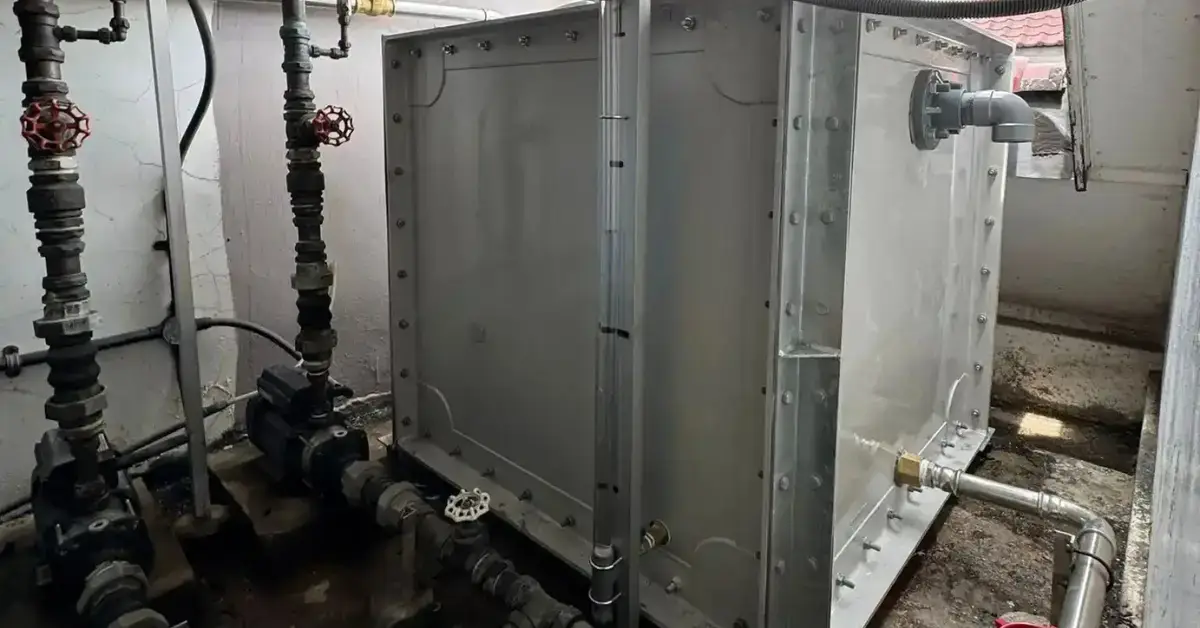
Magtech has supplied, installed and replaced sectional panel water tanks in Singapore since 1995. Clean water at the tap is the whole point of the product, so the tanks we supply are built to the standards the regulations actually name.
- FRP/GRP tanks tested to SS 245:2014, the standard PUB requires for potable sectional FRP tanks, with WRAS-approved water-contact materials.
- Grade 316 stainless steel for potable water, which is the minimum grade the Code of Practice allows for stainless potable tanks. Our note on SS304 versus SS316 explains why.
- Designed to be inspected and cleaned. Manholes per compartment, ventilation, clearance for the annual visit. A tank that is hard to clean is a tank that does not get cleaned.
- A two-year warranty on manufacturing defects, on top of a service life we publish rather than promise.
We also know that a good tank is only part of the last mile. The pipes after the tank, and the years between cleanings, are where water quality is lost, and the customers we hear this from most are landed homeowners and residents of older estates.
That is why we are now actively evaluating reverse osmosis (RO) water filters and similar solutions for Singapore homes, with the same attitude we take to tanks: the specification has to be real and the after-sales has to exist. We are visiting the factory this month. We have not chosen the product yet, and we will not sell one until we are satisfied with it.
If you would like to know when it is ready, leave your details here and we will tell you first. One message when the product is available and one when pricing is confirmed. Nothing else.
If you have a landed property and are not sure when the tank was last cleaned, do not wait for the filter. Contact us and we will point you to a cleaning partner.