Client Notice
Pricing update from October 2026: Revised pricing will apply due to continued increases in material, manufacturing and logistics costs.

Client Notice
A pressed steel water tank is a bolted sectional tank built from hydraulically pressed mild steel panels, hot-dip galvanised to ISO 1461. In Singapore it is the standard choice for fire protection storage — sprinkler, hosereel and wet riser tanks — because fire specifications are written to SS 22 and to LPCB listing rather than to any single manufacturer.
Installation, replacement and repair support across Singapore and Asia.
Hot-Dip Galvanised Mild Steel
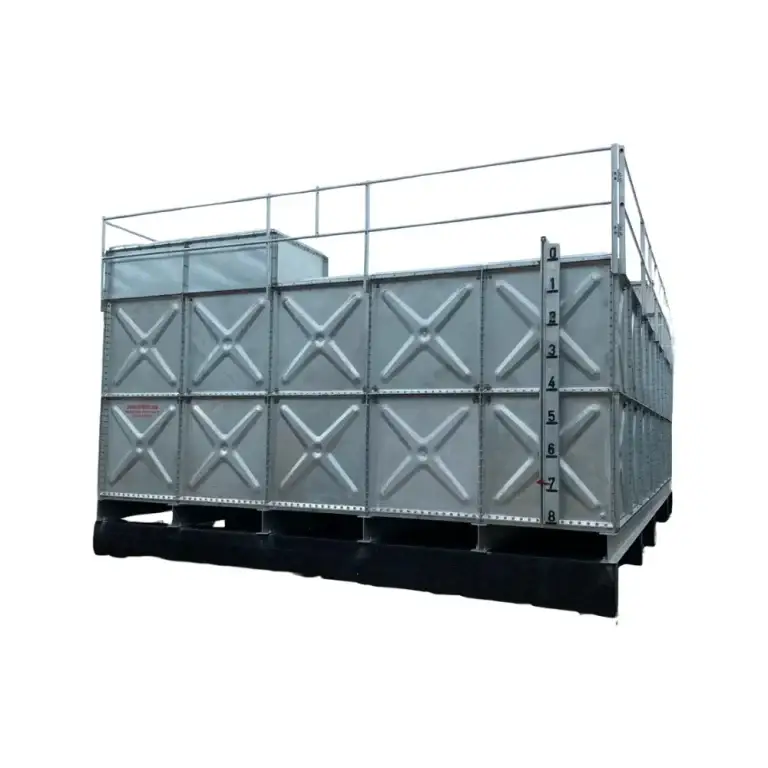
Fire protection water storage
SS 22
1.0 m or 1.22 m
20–25 Years
Dedicated water storage for automatic sprinkler systems designed to control and suppress fires.
Reliable fire-water storage supporting manual hosereel systems within commercial and industrial buildings.
Fire-water storage for wet-riser systems serving multiple levels in high-rise developments.
Suitable for selected make-up and building-service water duties where the required finish or lining is confirmed.
SS 22 is a Singapore Standard rather than an SCDF certification. Project fire specifications may reference the standard through applicable fire-safety requirements, so the exact compliance and listing required should be confirmed with the consultant.
SS 22:1979 is listed as obsolescent on the Singapore Standards eShop and covers sectional tanks constructed from 1220 mm square pressed steel plates. However, it continues to be referenced in Singapore fire-protection specifications. The applicable standard and required LPCB listing should therefore be confirmed with the project consultant.
SS 22 & LPCB requirements
Design standard & plate thickness
Fire protection & non-potable use
Want a broader introduction to HDG pressed steel tanks? Learn how the panels are formed, how the hot-dip galvanising process protects the steel, and where these tanks are commonly used.
Download Our Water Tank Brochure
View Magtech’s sectional water tank products, applications and available installation services.
Mild-steel plates are hydraulically pressed into flanged sectional panels to provide structural stiffness. After fabrication, the panels and associated steel components are immersed in molten zinc so the protective coating reaches the surfaces, folds, edges and bolt holes.
The panels are transported separately and assembled on site using sealed bolted joints. Internal, external or hybrid reinforcement is selected according to the approved tank design, structural requirements and required access for inspection and maintenance.
You can compare FRP, pressed steel and stainless steel tanks before selecting a system.
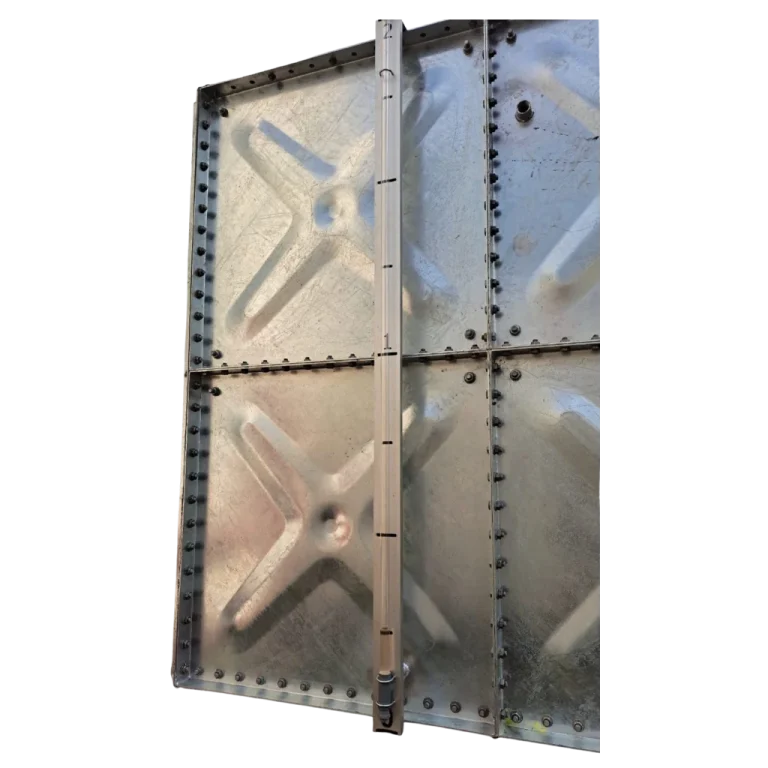
Ribbed and flanged steel panels provide the stiffness required to resist water pressure.
Galvanising after fabrication protects panel surfaces, edges, folds and bolt holes.
Modular panels are transported separately and assembled within the available installation area.
Internal, external or hybrid reinforcement can be selected according to structural and maintenance requirements.
1.0 m / 1.22 m
4.0 m / 4.88 m
20–25 years
Capacity is set by footprint and height. Using 1.22 m imperial modules, a 1220 × 1220 mm tank at one module high holds approximately 1.82 m³, and the tabulated range extends to roughly 1,229 m³ at a 15,860 × 15,860 mm footprint at 4.88 m high. Metric 1.0 m modules run to approximately 507 m³ at 3 m high and 676 m³ at 4 m.
Those are nominal figures with no freeboard. Effective capacity is always lower once freeboard and fittings are accounted for, so confirm the effective requirement rather than the nominal one before a tank is sized. We will do that calculation as part of any quotation.
↔ Swipe horizontally to view all table columns
| Tank Height | Panel Tier | SS 22 (Default) | SANS |
|---|---|---|---|
| 1.0–1.22 m | Bottom and side tiers | 5 mm | 3 mm |
| 2.0–2.44 m | Bottom and side tiers | 5 mm | 3 mm |
| 3.0–3.66 m | Bottom and first tier | 5 mm | 4.5 mm |
| Second and third tiers | 5 mm | 3 mm | |
| 4.0–4.88 m | Bottom and first tier | 6 mm | 6 mm |
| Second tier | 5 mm | 4.5 mm | |
| Third and fourth tiers | 5 mm | 3 mm |
↔ Swipe horizontally to view all table columns
| Item | Specification |
|---|---|
| General Application | Water storage for air-conditioner make-up, firefighting, and food production with Food Grade Epoxy Coating. |
| Standards | Rectangular pressed steel sectional water tanks constructed with hydraulically pressed flanged panels conforming to B.S. 1564 and hot-dip galvanised to ISO 1461:2009. |
| Materials | Mild steel used for the plates, stays, cleats and pads conforms to BS EN 10025:2004. |
| Tank Panels | Tank panels measuring 1.22 × 1.22 m or 1.0 × 1.0 m are hot-dip galvanised to ISO 1461:1999. |
| Tank Covers | Standard tank covers are hydraulically pressed, available in 3.0 mm or 1.5 mm thicknesses, and sized at 1.22 × 1.22 m or 1.0 × 1.0 m. The covers are also hot-dip galvanised. |
| Stays and Cleats | The sides and ends of the tank are supported by stays at the junction of two or more plates. The stays and cleats are manufactured from mild steel and hot-dip galvanised. |
| Bolts and Nuts | Bolts, studs, nuts and washers conform to B.S. 4190 and are hot-dip galvanised. |
| Joining Compounds | Non-toxic, odourless PVC foam sealant and butyl sealant, or an approved equivalent, are supplied. |
| Manhole and Vent | Each tank or compartment includes one 600 × 600 mm manhole and one 100 mm diameter vent with an insect-proof attachment on the tank cover. |
| Ladders | Hot-dip galvanised ladders are provided for internal and external tank access. Aluminium ladders are available on request. |
| Level Indicator | A mild-steel or galvanised indirect-reading level indicator is available on request. |
| B.S. 1564:1975 (Revised) | Designed for cold liquid with a density of 1.0 and a temperature not exceeding 38°C. |
| Tank Height: 4 ft | Bottom, sides and ends: 5 mm. |
| Tank Height: 8 ft | Bottom, sides and ends: 5 mm. |
| Tank Height: 12 ft | Bottom, sides and ends: 5 mm. |
| Tank Height: 16 ft | Bottom and first tiers of sides and ends: 6 mm. Second, third and top tiers of sides and ends: 5 mm. |
Support centres must match the selected system: normally 1.0 m for metric or 1.22 m for imperial modules.
The supporting base must be level, with a maximum tolerance of ±6 mm across the tank base unless the approved design specifies otherwise.
Allow approximately 500 mm around and below the tank and at least 750 mm above the roof.
The reinforced-concrete plinth is normally a separate contractor’s scope and must be completed before installation. Tanks above 3,000 mm may also require steel capping flats on the concrete support.
Typical fittings include a lockable manhole, insect-proof air vent, ladders, level indicator and flanged nozzles.
Material is not a free choice in Singapore. The application determines it, and specifying the wrong one produces a rejected submission rather than a saving.
↔ Swipe horizontally to view all table columns
| Tank Material | Suitable Applications | Standard or Requirement | Product Page |
|---|---|---|---|
| FRP / GRP | Potable & non-potable | SS 245:2014 — mandatory for potable water storage since 1 June 2019 | View Product → |
| HDG Pressed Steel | Fire protection | SS 22; LPCB listing where specified | View Product → |
| SS304 Stainless Steel | Non-potable only | Suitable for non-potable water; not permitted for potable service | View Product → |
| SS316 Stainless Steel | Potable & high-spec | PUB’s stipulated standards require Grade 316 stainless steel or better for potable water storage. The complete water service installation must also comply with SS 636 and prevailing PUB requirements | View Product → |
Widely specified for sprinkler, hosereel and wet-riser water storage in Singapore.
Hydraulically pressed panels provide structural stiffness for large-capacity storage.
The zinc coating protects panel surfaces, folds, edges and connection points.
A durable option for exposed plant areas, rooftops and external installations.
Metric and imperial modules support different footprints, heights and compartment arrangements.
Individual damaged panels can be replaced without necessarily replacing the complete tank.
Installation is carried out by our own Singapore crews rather than subcontracted teams, with several installers bringing 10 to 20 years of experience in sectional tank installation and replacement works.
Our in-house installation team delivers safe, efficient works with minimal disruption to your operations.
We specialise in water tank replacement for ageing or leaking systems, ensuring reliable performance and compliance with current standards.
We diagnose and repair tank issues quickly, helping to stop leakage, extend lifespan and avoid unnecessary full replacement.
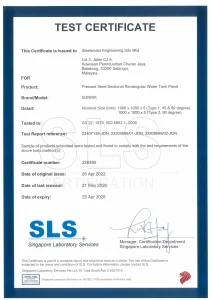
SS 22:1979
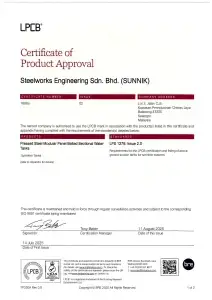
LPCB Sunnik
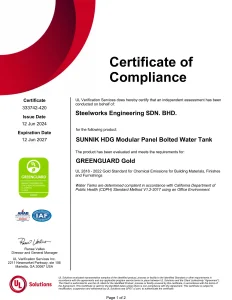
GREENGUARD Gold
2 Years
Our standard warranty for manufacturing defects is two (2) years from the date of tank completion. This may be reviewed and adjusted upon mutual agreement, depending on project requirements.
1 Year DLP
The Defects Liability Period (DLP) for workmanship is one (1) year from the date of completion of installation.
Short answers to the questions most often raised during tank selection and quotation review.
Pressed steel is mild steel plate that has been hydraulically pressed into a ribbed panel at 45° and 90° to the face. Pressing the panel gives it structural stiffness that a flat plate of the same thickness would not have, which is what allows a bolted sectional tank to hold its shape under load.
They describe different things. Pressed steel is the panel forming process; HDG, or hot-dip galvanising, is the corrosion protection applied afterwards to ISO 1461. An HDG pressed steel tank is both.
For more details, read What is an HDG pressed steel water tank? →
No. HDG pressed steel is intended for fire-protection and selected non-potable duties in Singapore. For potable storage, use an FRP/GRP tank tested for compliance with SS 245:2014 or a stainless steel sectional tank using Grade 316 or better in accordance with PUB’s stipulated standards and prevailing water-service requirements.
Learn more: HDG Pressed Steel vs FRP Water Tanks →
A hot-dip galvanised pressed steel tank has a typical service life of 20 to 25 years in Singapore conditions, provided annual inspection and maintenance are carried out.
Learn more: how long do water tanks last in Singapore? →
Yes. Bolted sectional construction means a damaged panel can be replaced without dismantling the whole tank, which is usually the difference between a repair and a replacement.
Read the Water Tank Replacement Methodology →
It depends on the reinforcement design.
Send us the required effective capacity, available space, intended water use and project drawings. Our team can review the information and advise on the next step.
Office Contact Update
Due to our ongoing office relocation, our main office contact line is currently being redirected while we complete the necessary updates.
For all enquiries in the meantime, please contact us at +65 8700 1377.
We apologise for any inconvenience and appreciate your understanding.