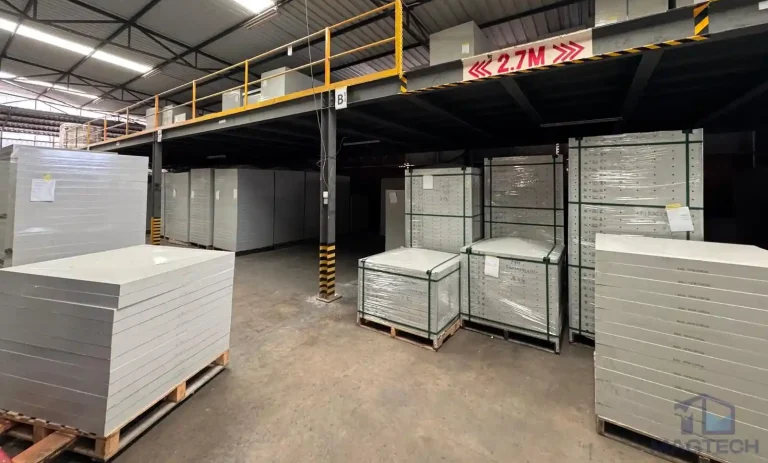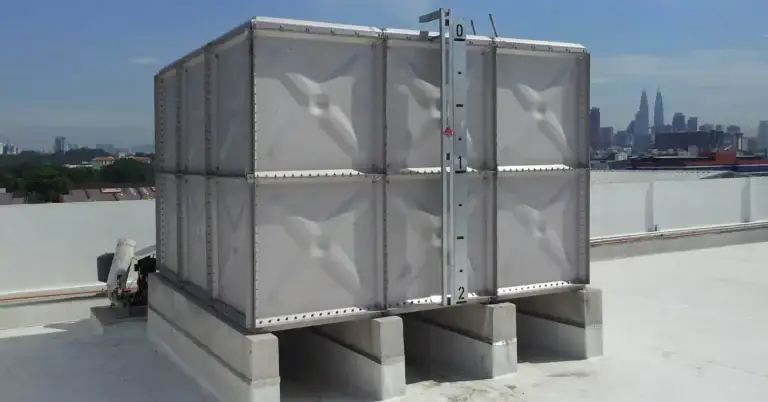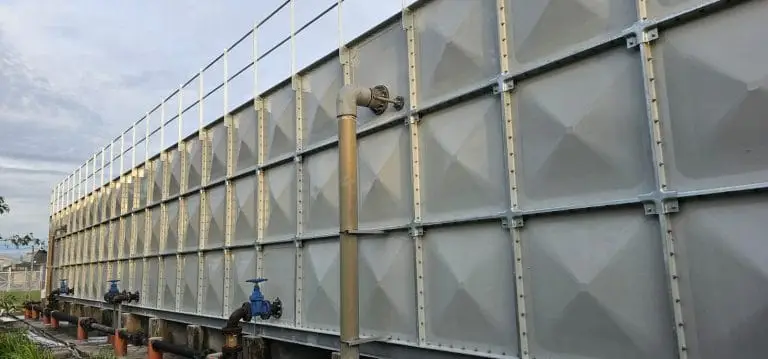
Panels are 1.0m modules with 0.5m half-panels, in tank heights up to 4.0m. If the terminology is what brought you here, we cover it separately: [FRP vs GRP vs SMC — what’s the difference?]
HDG vs FRP at a glance
| HDG pressed steel | FRP / GRP | |
|---|---|---|
| Material | Mild steel S275, hot-dip galvanised (ISO 1461) | Fibreglass composite (hot-pressed SMC panels) |
| Design standard | BS 1564:1975, SS 22 | SS 245:2014, BS EN 13280 |
| Typical application in SG | Fire protection (sprinkler/hosereel), non-potable, outdoor | Potable water, domestic storage, chilled water |
| Fire tank specifications | The default — SS 22, LPCB listed | Not the specified material |
| Potable water (PUB) | Not the compliant sectional choice | Required choice since 1 June 2019 (SS 245:2014) |
| Corrosion | Zinc coating protects the steel; rated pH 6–8 | No corrosion — no metal in contact with water |
| Panel modules | 1.22m (4ft) and 1.0m | 1.0m and 0.5m |
| Max standard height | 4.88m (16ft) | 4.0m |
| Typical service life | 20–25 years | 15–20 years |
| Supply cost | Higher than FRP | The lowest-cost tank material |
Which tank do I need for drinking water?
FRP. Since 1 June 2019, only FRP/GRP sectional tanks tested for compliance with SS 245:2014 may be supplied and installed for potable water service in Singapore, under PUB’s water storage tank requirements. An HDG tank — however well galvanised — is not the compliant sectional choice for a potable submission. Where a client prefers metal for potable storage, the route is stainless steel at minimum Grade 316 under PUB’s requirements, which is a different cost class again: see [SS304 vs SS316].
Which tank do I need for fire protection?
HDG pressed steel. Fire protection tank specifications in Singapore — sprinkler tanks, hosereel tanks, fire water storage — are written around SS 22, the Singapore Standard for pressed steel sectional tanks, with LPCB listing where the specification requires it, under SCDF Fire Code requirements. Fire water does not need potable-grade material, so specifying FRP or stainless steel there is normally paying for compliance the application doesn’t ask for.
This is why the choice is rarely a preference question: the water decides. Drinking water points to FRP; fire water points to HDG. Most buildings with both requirements simply have one of each.
What are internal and external stays — and why should you care?

Every pressed steel tank needs bracing against water load, and there are three ways to do it. This is the specification detail most quotations never explain, and it moves the price materially:
- Internal stays — galvanised angle bracing inside the tank, tying panels to the floor and to each other. The standard practice in Singapore and the most economical design. Most local tanks are built this way.
- External stays — hot-dip galvanised universal beams and brackets outside the tank, with no internal bracing. Nothing inside the water space, easier internal cleaning — but a more expensive structure.
- Hybrid — both internal and external. Specified in markets with stability requirements Singapore projects rarely carry; substantially more expensive and rarely needed here.
The practical point: two “same size” HDG tank quotations can be priced on different stay designs. Before comparing totals, confirm which design each price is built on. We state it on every quotation — ask any supplier to do the same.
Which lasts longer?
In published service-life terms, HDG pressed steel typically serves 20–25 years and FRP/GRP 15–20 years in Singapore conditions — both subject to water quality and maintenance. The failure modes differ: an HDG tank’s life is governed by its zinc coating (and is rated for water in the pH 6–8 range), while an FRP tank cannot corrode at all and can be repaired panel by panel. Both are sectional, so in both cases individual panels can be replaced rather than the whole tank.
Which costs less?
For the tank itself, FRP is the lowest-cost material — the usual supply-cost order in Singapore runs FRP, then HDG, then SS304, then SS316. But the comparison is rarely a live choice, because the application dictates the material: you cannot save money by putting an HDG tank on a potable application or an FRP tank on an SS 22 fire specification.
We don’t publish ballpark prices — any contractor who quotes a tank over the phone is guessing. What a real figure needs is capacity, height, stay design (for HDG), nozzle count, access and regulatory scope. We cover where the money actually goes in [what affects water tank replacement cost in Singapore].
What finish options does an HDG tank have?
The standard finish is hot-dip galvanising to ISO 1461, inside and out — for most fire protection and non-potable applications, that is the whole answer. Other internal linings and material upgrades exist for specific duties; if your specification calls for something beyond standard HDG, contact us with the requirement and we’ll confirm what the manufacturer supports.
Get the material question answered before it costs you
Send us your specification, drawing, or a photo of the tank you’re replacing. We’ll confirm which material the application requires, and return an itemised quotation that states exactly what it’s priced on — stay design included.
+65 8700 1377 · admin@magtechgeneral.com.sg
Magtech General Construction & Trading Pte Ltd — sole Singapore distributor of SUNNIK sectional panel tanks. Established 1995, 35+ years of experience, 4,000+ projects.