Client Notice

Pricing update from October 2026: Revised pricing will apply due to continued increases in material, manufacturing and logistics costs.
Water Quality & Filtration
Water Solutions Insight #24

Landed House Water Tanks in Singapore: Why the Annual Certification Rule Doesn’t Apply, and What That Means for You

If you own a landed house in Singapore with a water storage tank, the date for cleaning it is yours to set. PUB’s rules put the responsibility for the tank on the owner, and for good reason. This article explains where the rules draw the line, why they draw it there, and what a sensible owner does about it.
SK

Written by

Seah Kevin

Sales Manager, Magtech General

Where PUB’s responsibility ends and yours begins

PUB’s Water Supply (Network) Department operates and maintains the water mains and connecting pipes up to your water meter. From the meter onwards, the water service installation is the consumer’s to maintain. That is the position in PUB’s own Handbook on Application for Water Supply, and it applies to every premises in Singapore, from an HDB block to a bungalow.

In a condominium or an office building the “consumer” is the MCST or the building owner, and the law requires them to engage a PUB Licensed Plumber at least once every 12 months to inspect, clean and disinfect where necessary, and certify the water storage tank. That certificate is submitted to PUB. Missing the date is an offence.

In a landed house, the consumer is you. The same duty of maintenance applies. What does not apply is the mandatory annual certification.


Why landed houses are treated differently

Two parts of the rules explain it, and both make sense.

First, most landed houses do not need a tank at all. PUB maintains mains pressure capable of supplying water fittings directly up to 25 metres above mean sea level. Only fittings above that height must be fed through a storage tank. A typical two-storey house on flat ground sits well below 25 m, so its taps can run straight off the mains with no tank in between. For landed premises with fittings above 25 m, PUB gives owners the flexibility to decide when to install the tank, provided the space and structural loading for it are built in from the start.

Second, the annual certification is written for shared installations. The Handbook applies it to every installation with a storage tank “except in residential premises without master meter”. A condominium takes its supply through a master meter and serves hundreds of households from one tank; a landed house takes its supply through its own meter and serves one family. PUB’s public guidance says it plainly: the mandatory annual certification does not apply to landed residential properties with a water storage tank after the sub-meter. The owner is responsible to engage a Licensed Plumber to clean and maintain the tank regularly so that the water is fit and safe for consumption.

So the rule is not that landed tanks matter less. It is that for one household’s own tank, the owner is trusted to do the maintaining. The rest of this article is about doing it.


What a landed-house tank actually looks like

Where a landed house does have a tank, it is usually there for pressure or for a third storey, and it is typically small: one to two cubic metres is common. Water comes in through a float valve, leaves through an outlet to the house pipework, and has an overflow pipe for when the float valve fails.

In our experience the tank is in one of two places. Roof storage is either out on the roof itself or tucked into the attic above the top-floor ceiling. Outdoor storage is at ground level, either in its own tank room or simply standing in the open beside the house. A few older houses have a third kind: a concrete tank built into the structure, which can be hard to find at all.

The ones that get forgotten are the ones nobody walks past. An attic tank sits behind a ceiling hatch that is opened once in years, and a built-in concrete tank may not be known to the current owner. If you have bought an older house and are not sure whether it has a tank, it is worth finding out.

Older tanks are pressed steel or early fibreglass; newer ones are FRP/GRP or stainless steel sectional panels. Whatever the material, the tank has the same job as the big ones on a condominium roof: hold a day’s water without letting anything in.

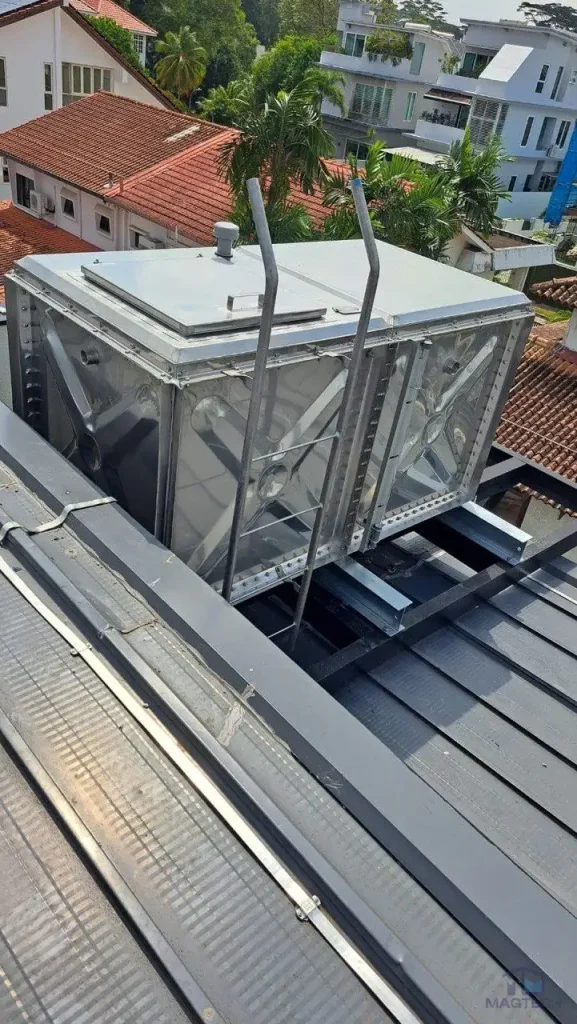
SS316 water tank installation at 11 Greenleaf View Singapore - completed rooftop tank with access ladder

What the Code of Practice expects of any storage tank

SS 636, the Code of Practice for Water Services, sets out how a storage tank should be built and kept. The clauses that matter most to a homeowner are simple to check:

  • The inspection cover fits closely, is hinged or chained to the tank, and is closed, secured and locked. Covers, hinges and chains are made of material that does not corrode.
  • Every gap is sealed, including around the cover and any electrode holders, so that no animal, insect or foreign material can get in.
  • Vents and the overflow are screened with fine stainless-steel mosquito-proof netting.
  • The overflow pipe does not run continuously into a drain. It discharges to open air so nothing can flow back from the drain into the tank.
  • The tank is not directly below any sanitary pipe, waste pipe, rainwater downpipe or other pipe carrying fluid that could contaminate it.
  • Cleaning and disinfection follow Annex A of SS 636, the same procedure a Licensed Plumber uses on a condominium tank.

None of this is onerous. It is the difference between a tank that stays clean between cleanings and one that does not.


What we find in landed tanks
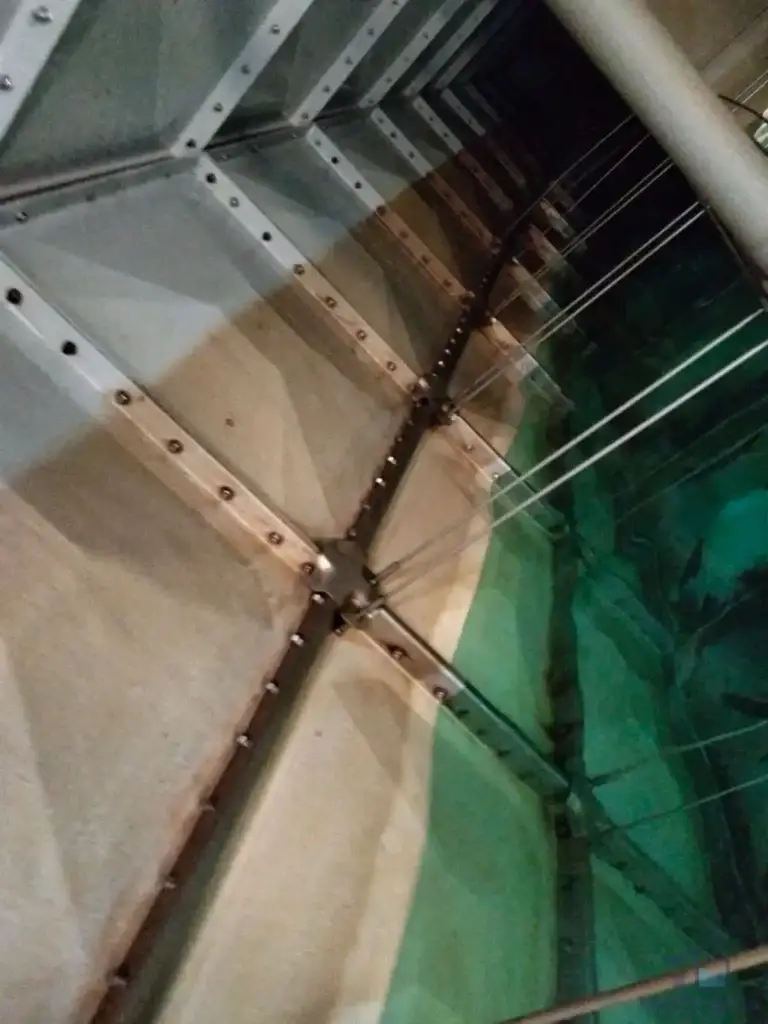
Sediment and algae inside a landed-property water tank in Singapore before cleaning

Magtech specialises in sectional panel tanks, so those are the tanks we know best. A tank that is cleaned and looked over every year stays in good order for decades. A tank that has not been maintained for a long time is a different story, whatever it is made of, and when we open one the same four things come up again and again:

  • Years of dirt and sediment build-up on the floor of the tank, stirred up every time it refills. In a tank that has never been drained since it was installed, it is a layer, not a dusting. We see it most in tanks that stand in direct sunlight and have gone without maintenance.
  • Critters getting in through gaps. Over the years a gasket works loose, a cover seal lifts, a vent screen tears, a gap opens at a pipe entry. Insects crawl in through a gap a few millimetres wide; lizards do not need much more. In Singapore a standing-water breeding site is also a dengue concern. Regular maintenance is what catches those gaps while they are still small.
  • A long-term leak at a joint or fitting that has been quietly running for years, sometimes with the owner’s water bill as the only clue.
  • Algae wherever light gets in.

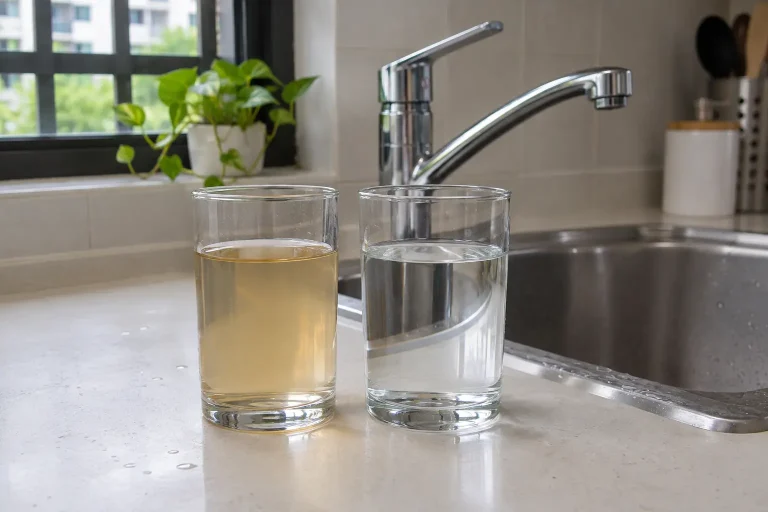
None of it shows up in PUB’s published water quality figures, because those figures describe the water PUB supplies, and that water is excellent. It shows up at the kitchen tap: a brown run after a holiday, a taste in the morning, something floating in the glass.


A maintenance routine for a landed tank

Keep it simple and do it on a date you will remember.

  1. Find the tank and look at it twice a year. Cover closed and locked, gaps sealed, screens intact, overflow discharging to open air, no drip at the joints. Ten minutes.
  2. Have it cleaned and disinfected once a year. Landed houses are not under the same yearly rule as condominiums and commercial buildings, but once a year is what we recommend: it is the interval the regulated premises work to, and it is a reasonable one for a family house. The tank is drained, the sediment scrubbed out and the tank disinfected to the Annex A procedure, and a water sample can be taken if you want one.
  3. Flush after an absence. Run the kitchen tap for a few minutes when you come back from a trip, so stagnant water in the pipes is cleared.
  4. Fix leaks and float valves when you find them, not later. A float valve that does not shut costs you water every day; a joint that weeps will not stop on its own.
  5. If you ever suspect contamination, tell PUB. The regulations ask every person maintaining an installation to notify PUB immediately of any contamination that comes to their knowledge. PUB’s hotline is 1800-CALL-PUB.


When the tank is past cleaning

Sometimes the cover comes off and the answer is not a clean but a replacement: corroded panels, a floor that has gone soft, bolts that shear when touched. There is no fixed age at which a tank should be replaced. It depends on the brand of the tank and the condition it is in, so the sensible step is to have a professional assess it before you decide.

Repairing and replacing tanks has been Magtech’s own work since 1995. A replacement for a landed house means a compact FRP/GRP or stainless-steel sectional tank, built to the standards the Code names, with a cover that locks and screens that fit. Our pages on tank repair and tank replacement explain what is involved.


The last metre

A clean tank is most of the answer, but the water still has to travel through your house pipework to the tap, and in an older house that pipework may be galvanised iron reaching the end of its life. Our article on whether Singapore tap water is safe covers what old pipes do to water and what you can do about it.

For the water you actually drink, a point-of-use filter at the kitchen tap is the last step. We are preparing water filters for Singapore homes, starting with landed properties, with the same attitude we bring to tanks: the specification has to be real and the after-sales has to exist. If you would like to be told when they are ready, leave your email below. Launch updates only.

If you cannot remember when your tank was last cleaned, contact us with a photo of the tank if you can reach it, and we will advise on the next step.
Recent Posts

COMING SOON

Water filter pre-launch

Receive an update when product details, availability and pricing are confirmed.

Register your interest

Be the first to know when the product is ready.

Tell us which format you are interested in. Your response will help Magtech plan the product range and launch information.

01

Product and launch updates

02

No purchase commitment

03

Clear information before release

REGISTER YOUR INTEREST

Tell us what you’re looking for

Complete the short form below so we can understand your requirements and contact you when the product is ready.

No payment required. We’ll only contact you regarding this product launch.

Frequently asked questions

Water Quality & Filtration questions

No. PUB states that the mandatory annual certification of water storage tanks does not apply to landed residential properties with a tank after the sub-meter. The owner remains responsible for engaging a Licensed Plumber to clean and maintain the tank regularly.

No. PUB maintains mains pressure to supply fittings directly up to 25 m above mean sea level, so many landed houses are fed straight from the mains. A tank is needed where fittings sit above that height, and PUB lets landed owners decide when to install it.

PUB asks owners to have it cleaned and maintained regularly by a Licensed Plumber. Landed houses are not under the yearly rule that applies to condominiums and commercial buildings, but once a year is what we recommend, for the same reasons that interval was chosen for them.

PUB asks owners to engage a Licensed Plumber, and the cleaning and disinfection procedure is in Annex A of SS 636.

Under SS 636 the inspection cover should be close-fitting, hinged or chained to the tank, closed, secured and locked, with all gaps sealed and vents screened so that no animal, insect or foreign material can get in.

Possibly the tank, possibly stagnant water in the pipes, possibly old galvanised pipework. PUB’s advice is to run the taps until the water clears and to call 1800-CALL-PUB if it has not cleared after 10 to 15 minutes. If it happens regularly, have the tank and pipework looked at.

Continue reading

Related industry insights