First, what certification is and is not
A certification means an independent body has tested a particular model against a published standard and continues to audit it. Three things follow from that.
It is specific to the model. A manufacturer’s 600-litre-a-day unit being certified says nothing about its 75-litre unit.
It is specific to the claim. A filter can be certified to a standard for one contaminant only. “Certified to NSF/ANSI 42” can mean chlorine taste and odour reduction and nothing else.
It is not the same as “tested to”. A laboratory can test a product against a standard and issue a report; that is a test, and the manufacturer may or may not have passed every part of it. Certification is the ongoing listing by the certifying body. If a box says “tested to NSF standards” rather than “certified”, ask for the listing.
None of this is a criticism of the standards. It is the reason they are worth reading properly.
NSF/ANSI 42: aesthetic effects
This is the standard you will see most often on filters sold in Singapore, and it is the right one for our water. It covers aesthetic, non-health claims: chlorine, taste and odour, chloramine, and particulate reduction by class. It also requires that the materials in contact with the water are safe, and that the unit is structurally sound.
What it does not cover is anything to do with health contaminants. A filter certified under 42 alone has not been tested for lead, cysts or chemicals. For Singapore’s water, where PUB’s 2025 table reports lead below 0.5 µg/L in the water leaving its plants against a limit of 10, and the thing most people want removed is the disinfectant taste, 42 is the relevant standard. The honest way to describe such a filter is “certified for chlorine taste and odour reduction”, and not “certified safe”.
One detail matters locally. PUB’s 2025 table reports monochloramine in the supply, at an average of 2.10 mg/L. Under NSF/ANSI 42, chlorine reduction and chloramine reduction are separate claims. So look for “Chloramine Reduction” on the listing. A chlorine or taste-and-odour claim alone does not show the filter was tested against chloramine.
NSF/ANSI 53: health effects
This standard covers contaminants with health effects, such as lead, cysts such as Cryptosporidium, mercury, asbestos and some volatile organic compounds. Each contaminant is a separate claim, so a filter certified to 53 for lead is not certified to 53 for cysts unless the listing says so.
Filters sold in markets with lead pipework lean heavily on 53. In Singapore the mains water does not carry those contaminants, so 53 is nice to have rather than necessary. Where it becomes relevant is inside a building with very old internal pipework, which is the one place a Singapore home can add something to its water that PUB did not put there.
NSF/ANSI 58: reverse osmosis systems
This is the standard for point-of-use reverse osmosis systems. The required claim is reduction of total dissolved solids, with optional claims for specific contaminants. A membrane can also be listed under 58 as a component. Most such listings are for material safety only, and say so in a footnote. That is not the same as the finished system being certified for what it removes. The listing will say which.
The standard applies only to reverse osmosis systems and their components. If a box for an ultrafiltration or carbon unit carries a 58 logo, ask for the listing.
The ones you will see less often
- NSF/ANSI 372 addresses lead content only: a maximum weighted lead content of 0.25% for most components. It is about the filter’s own materials, not the water.
- NSF/ANSI 401 covers emerging contaminants, such as traces of pharmaceuticals, herbicides and pesticides.
- NSF/ANSI 61 is for components of water systems such as pipes and fittings, not for treatment performance.
- NSF/ANSI 55 is for ultraviolet systems and 44 for cation-exchange softeners. Neither is common in a Singapore home.
The same standards, different certifiers
NSF International writes the standards and certifies to them, but it is not the only certifier. The Water Quality Association’s Gold Seal and IAPMO R&T certify products to the same NSF/ANSI standards. A product with a WQA Gold Seal to NSF/ANSI 42 is certified to the same standard as one NSF lists to 42. What matters is that the certifier is independent and the listing is public.
How to check a listing in five minutes
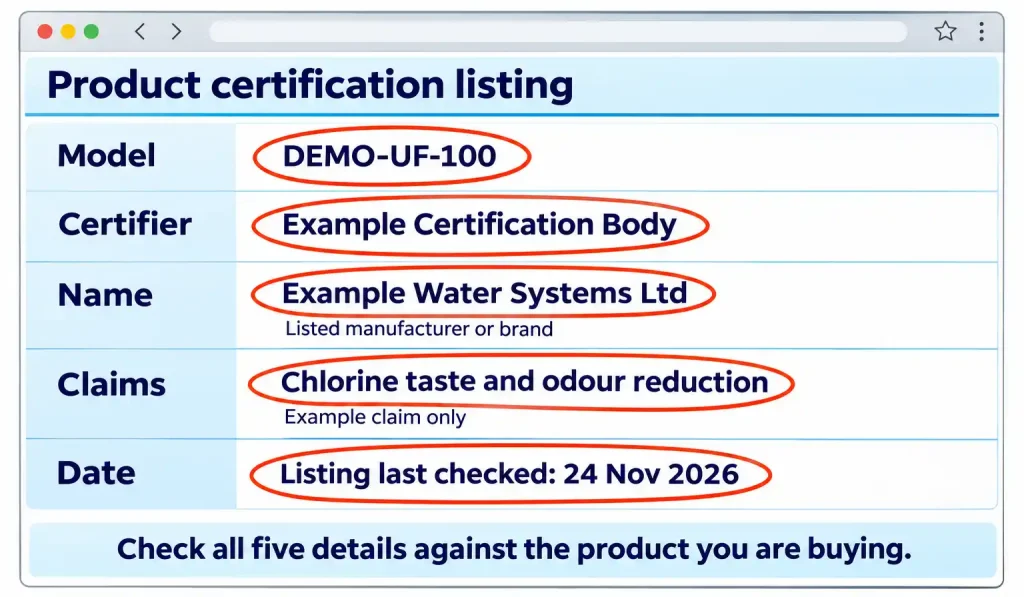
- Find the model number on the box or the manufacturer’s data sheet. Not the marketing name, the model code.
- Search the certifier’s public listings. NSF, WQA and IAPMO all publish theirs.
- Check that the listing is in the manufacturer’s name, or in the brand’s name with the manufacturer shown. A listing in some other company’s name does not transfer.
- Read the claims line by line. Note which standard, which contaminants, and the rated capacity in litres.
- Check the date. Listings lapse when a manufacturer stops paying for the audit.
If the seller cannot point you to the listing, treat the logo as decoration.
Electrical marks for powered units
Under-sink ultrafiltration and carbon units need no electricity. Reverse osmosis units with a pump, and every hot-and-cold dispenser, do, and that brings a different set of marks.
- CE is the manufacturer’s own statement that the product met EU requirements when it was placed on the market. No central EU body issues it, although some product types need testing by a notified body first.
- CB is a test certificate issued under the international IECEE CB Scheme, based on third-party testing of samples against an IEC standard, and it is accepted by the scheme’s national certification bodies. It covers electrical safety, not filtration.
- SAFETY Mark is Singapore’s own mark. Controlled Goods must be tested, registered with the Consumer Product Safety Office and carry the mark. The list includes “liquid heating appliances”, which covers kettles, air pots and hot water dispensers. Every mark has a unique 8-digit registration number that you can check at go.gov.sg/safety-mark. A dispenser that heats water should carry it.
A unit with no heating function is not named in the Controlled Goods list. Ask the seller for its electrical safety test report all the same.
What about PUB?
PUB sets standards and requirements for water fittings used in water service installations, and it is reasonable to ask a seller whether a plumbed-in unit’s fittings have been tested to those requirements. PUB’s own position on home filters is worth repeating: tap water is safe to drink directly from the tap without further filtration, and a filter that is not cleaned or replaced on schedule can become a breeding ground for bacteria. Any certification covers the filter as it leaves the factory, not the one that has sat under a sink unchanged for two years.
Why we care
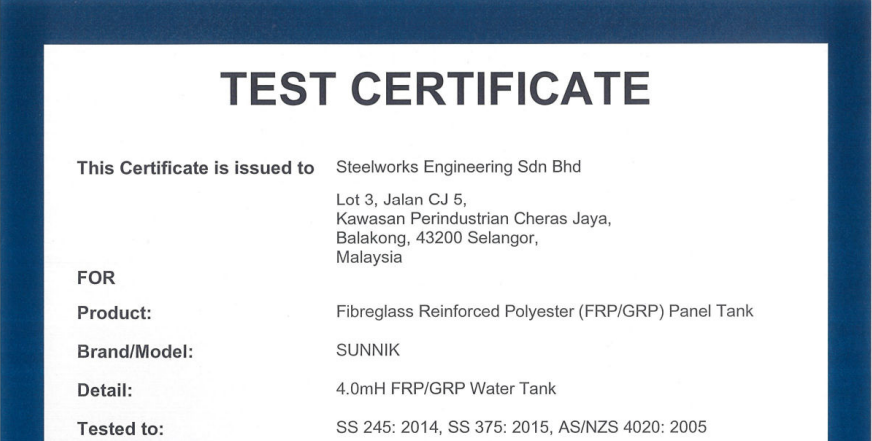
Magtech has sold water storage tanks in Singapore since 1995, and the drinking water tanks we supply are tested to the standards PUB stipulates for materials in contact with drinking water. Reading a test certificate line by line is something we do every week. When we started looking at water filters, the first thing we noticed was how loosely the logos were used. When our range is ready, the certificates we quote will be the ones we have seen in the manufacturer’s name, and the product page will say exactly which claims they cover. Until then, we are not quoting any.